Thyroid Health
Understand common thyroid disorders like hypothyroidism and hyperthyroidism, interpret TSH, T3 and T4 test results, and discover treatment options.
Written by Dr. Nimisha Gupta, M.D. Pathology
12–15 min

1. Your thyroid gland, in plain language
The thyroid is a small butterfly-shaped gland at the front of your neck, just below the Adam's apple. It weighs only 15–25 grams, but it sets the speed your whole body runs at — heart rate, weight, temperature, digestion, mood and periods.
It uses iodine from your food to make two hormones:
T4 — about 90% of output. The storage form: plentiful and long-lasting, but not very active.
T3 — the active form that does the work inside your cells. Only about 10% comes from the gland; your liver, kidneys and muscles make the rest by converting stored T4 as needed.
Where TSH comes from
The most important thing to know about TSH: it is not made by your thyroid.
It comes from the pituitary gland at the base of your brain, and it's an instruction — Thyroid Stimulating Hormone.
The system works like a thermostat:

This makes TSH read backwards.
If your thyroid is underactive, the pituitary shouts louder → TSH goes UP.
If your thyroid is overactive, the pituitary goes quiet → TSH goes DOWN.
Why TSH is tested first
1. The pituitary is far more sensitive than you are.
A small drop in thyroid hormone causes a large rise in TSH, so it shifts long before you feel unwell. One inexpensive test catches most thyroid problems.
2.Hypothyroidism — the body running too slow
Not enough hormone — everything slows. Symptoms build over months, so they're often blamed on stress or age.
Common symptoms: tiredness that sleep doesn't fix • weight gain without diet change • feeling cold when others aren't • dry skin, coarse hair, hair fall • constipation • puffy face and eyes • heavy or irregular periods • low mood, slow thinking, poor memory • muscle aches • hoarse voice • slow pulse • difficulty conceiving.
Common causes: Hashimoto's thyroiditis (immune attack on the gland — the leading cause), iodine deficiency in some regions, previous thyroid surgery or radioiodine, certain medicines, and the period after childbirth.
3.Hyperthyroidism — the body running too fast
Too much hormone — everything speeds up, usually faster and more noticeably than hypothyroidism.
Common symptoms: weight loss despite good appetite • fast or pounding heartbeat • feeling hot, sweating • anxiety, restlessness, irritability • trembling hands • loose stools • poor sleep • muscle weakness, especially thighs • lighter or absent periods • bulging or gritty eyes.
Common causes: Graves' disease (immune over-stimulation — the most common cause), an overactive nodule or multinodular goitre, thyroiditis (temporary inflammation), too high a dose of thyroid medication, and iodine-rich drugs such as amiodarone.
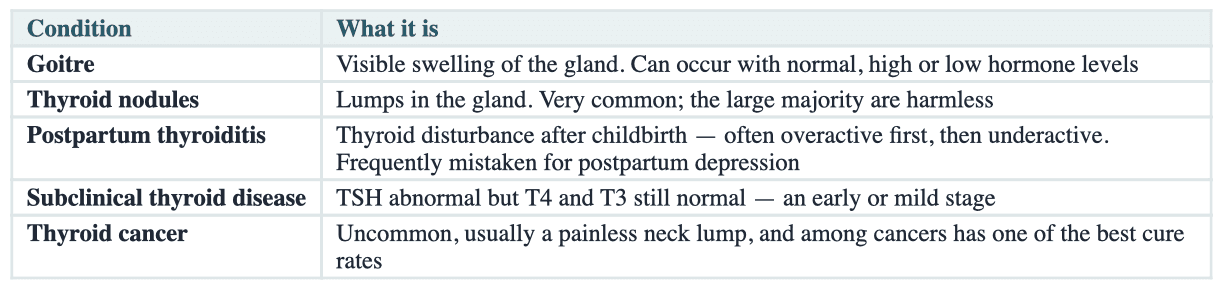
4.Other thyroid conditions
3. Thyroid disease in India
Hypothyroidism is far more common than hyperthyroidism — this is the headline. If you're being tested in India, an underactive thyroid is much the likelier finding.
A study across eight Indian cities found hypothyroidism in 10.95% of adults — roughly one in ten. Of these, 7.48% already knew, while 3.47% were previously undetected. Female gender and older age were both significantly associated with it. So around one in three affected adults doesn't know it.
Hyperthyroidism is much less common — typically around 1–2% of adults.
Iodised salt changed the picture. India once had a large "goitre belt" from iodine deficiency, which national salt iodisation largely fixed. A Delhi study of 4,409 adults two decades after universal salt iodisation found clinical goitre in 9.6% – 13.3% of women and 3.3% of men — with normal urinary iodine indicating the programme had succeeded, though subclinical hypothyroidism remained common.
The consequence: in urban India today the main cause of hypothyroidism is autoimmune (Hashimoto's), not iodine deficiency. Deficiency still matters in some rural, tribal and hilly areas.
Pregnancy needs attention. Indian studies commonly report thyroid problems in around 10% of pregnant women, mostly hypothyroidism and mostly subclinical. Untreated, it's linked to miscarriage, preterm birth and effects on the baby's brain development.
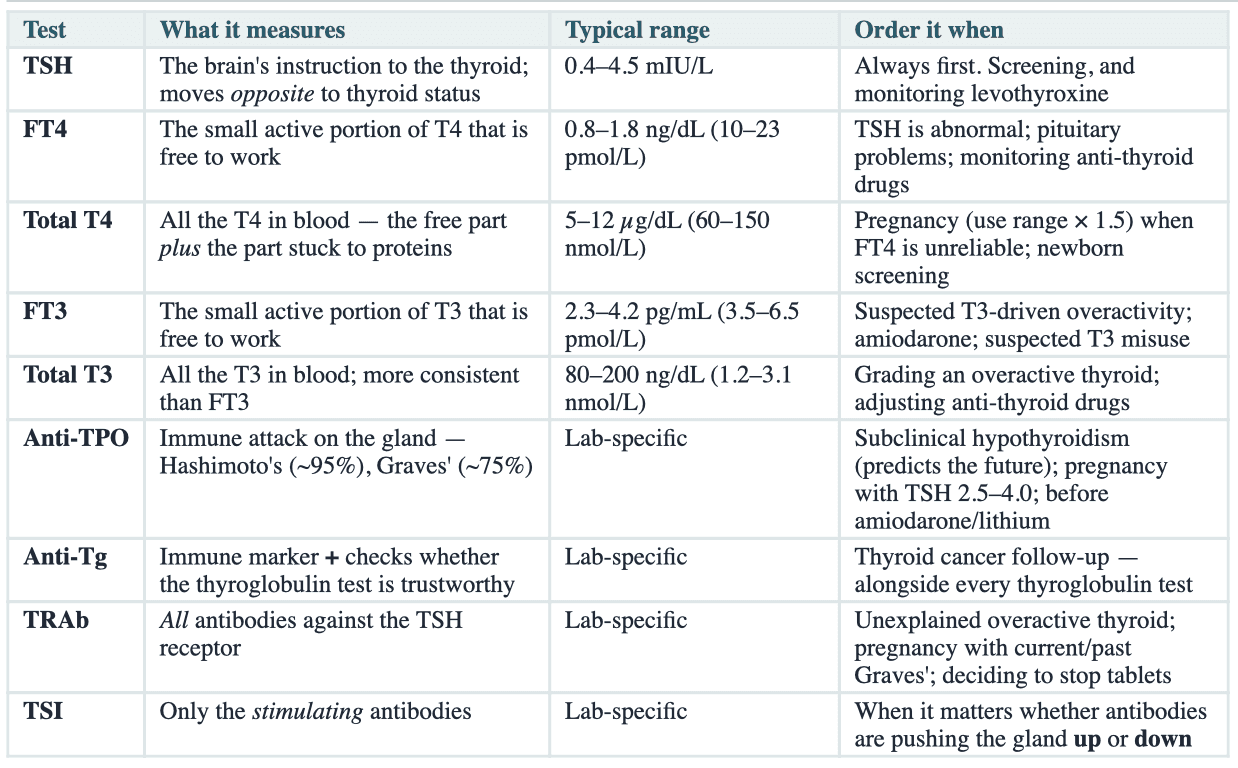
4. At a glance - all nine tests on one page
5. What to do based on your TSH result
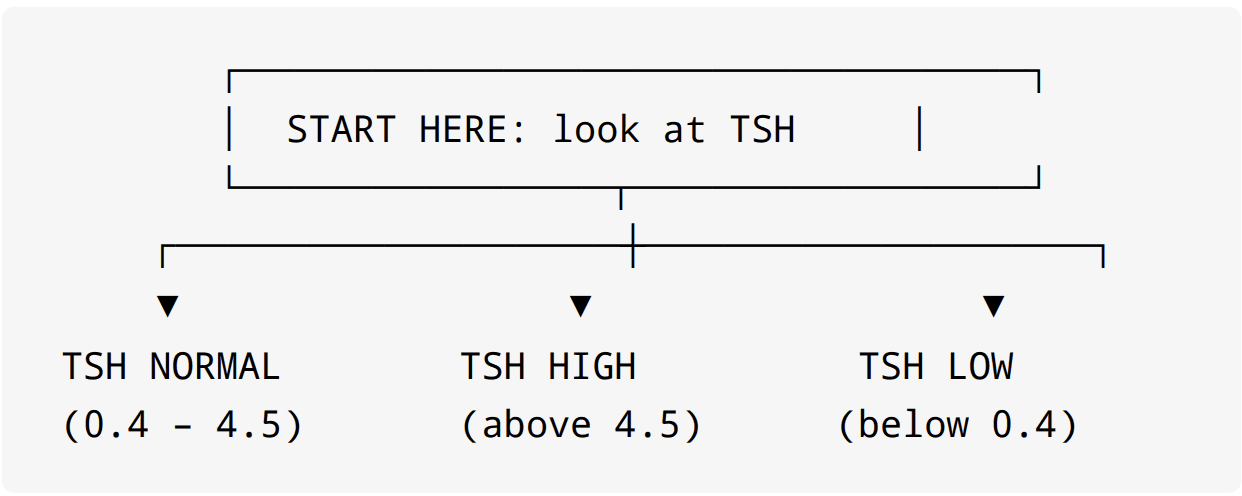
■ If your TSH is NORMAL
Your thyroid is very likely fine, and usually no further thyroid test is needed.
Ask about more testing only if you're pregnant or planning to be; have a neck swelling, lump or eye changes; take amiodarone or lithium; or have autoimmune disease in yourself or your family.
Still tired with a normal TSH? The thyroid is unlikely to be the problem — but something may be. Look for low iron, low B12, poor sleep, diabetes or depression. Repeating the thyroid test won't help.
■ If your TSH is HIGH — the underactive direction
Your pituitary is shouting because the thyroid isn't keeping up. Your doctor adds FT4. Don't ask for T3 — it can't diagnose an underactive thyroid.
Don't panic at one high TSH. A single mildly raised result is common after illness and often normal on repeat. Pregnancy is the exception — act promptly.

■ If your TSH is LOW — the overactive direction
Your pituitary has gone quiet because there's already too much hormone. Your doctor adds FT4 and total T3 to measure how overactive you are, then TRAb (and often a scan) to find the cause — treatment depends entirely on it.
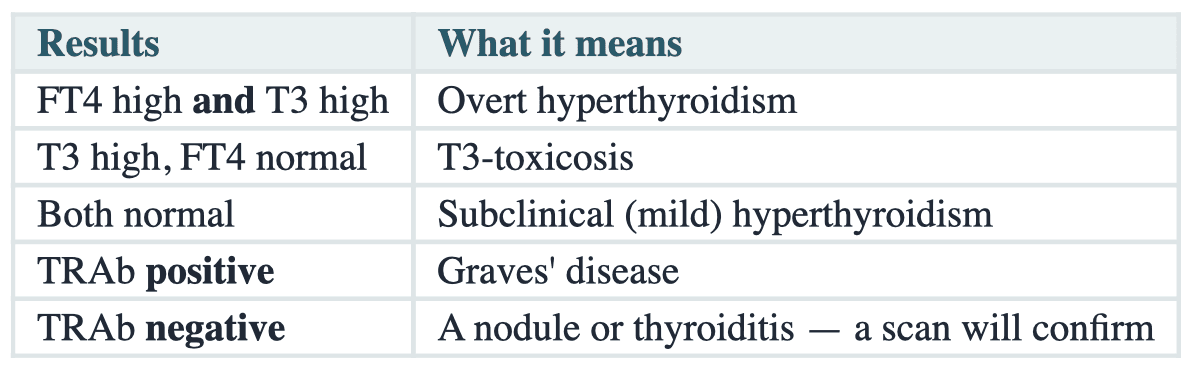
Already taking levothyroxine? A low TSH usually just means your dose is slightly too high. Tell your doctor before assuming anything else.
6. TSH explained
TSH is the instruction from your pituitary to your thyroid, and it reads in the opposite direction to your thyroid hormones. Typical range: 0.4–4.5 mIU/L.
Four things move TSH with no thyroid disease at all:
Time of day. Highest overnight, lowest mid-afternoon, varying by up to half. For a borderline result, timing alone can decide whether you're called abnormal — so test at the same time each visit.
Age. The normal upper limit drifts up. A TSH of 5–6 at 80 may be normal.
Waiting time. After a dose change, TSH takes 6–8 weeks to settle. Testing sooner gives a number still in motion and often triggers a dose change that wasn't needed.
Being unwell. Serious illness shifts results in ways unrelated to the thyroid. Wait until you've recovered.
When TSH can't be trusted at all
If the pituitary itself is damaged — by a tumour, surgery, radiation, or heavy bleeding after childbirth — it can't send the right instruction. TSH may look normal while you are genuinely hypothyroid.
Uncommon, but it's why doctors measure FT4 instead when they suspect a pituitary problem.

7. T4: free versus total
Most T4 in your blood isn't available for use — it travels stuck to carrier proteins, like passengers strapped into seats. About 99.97% is bound and inactive; only 0.03% floats free, and only that free part can enter your cells.
Free T4 measures only the active portion.
Total T4 measures everything — free plus bound.
Why total T4 misleads
Anything that changes the number of carrier proteins changes total T4, even in a perfectly healthy person.
More proteins = falsely high:
Pregnancy (roughly doubles them)
Oestrogen and oral contraceptives
Some liver conditions
Fewer proteins = falsely low:
Kidney disease with protein loss
Severe liver disease
Steroid tablets
Significant malnutrition
A pregnant woman with high total T4 and normal TSH is almost always fine — her carrier proteins doubled, her thyroid didn't.
When total T4 is still better
Mainly in later pregnancy, where the free T4 test becomes unreliable. Doctors then use total T4 against the normal range multiplied by about 1.5. Also used in newborn screening.
One caveat: routine free T4 is an automated estimate, not a direct measurement. If result and symptoms clearly disagree, a specialist can order the far more accurate free T4 by equilibrium dialysis.
8. T3: free versus total — and why the logic reverses
T3 works the same way, about 99.7% bound, 0.3% free, so in principle free T3 should be the better test.
In practice it usually isn't. The free portion is so tiny that machines struggle, and results vary noticeably between labs. Total T3 is often more reliable and repeatable, which is why specialists frequently prefer it when judging how overactive a thyroid is and when adjusting anti-thyroid tablets.
This is counter-intuitive: for T4, free is better; for T3, total often is. That's not physiology — it's the limits of lab technology.
The most common mistake with T3
Don't use T3 to diagnose an underactive thyroid. It's the single most frequently wasted thyroid test.
When T4 falls, your body compensates by converting more of it into T3, so T3 is protected and stays normal until things are quite advanced.
A normal T3 rules nothing out, and a low T3 usually reflects illness, stress or undereating — not a failing thyroid.
T3 earns its place in overactive thyroid problems, not underactive ones.
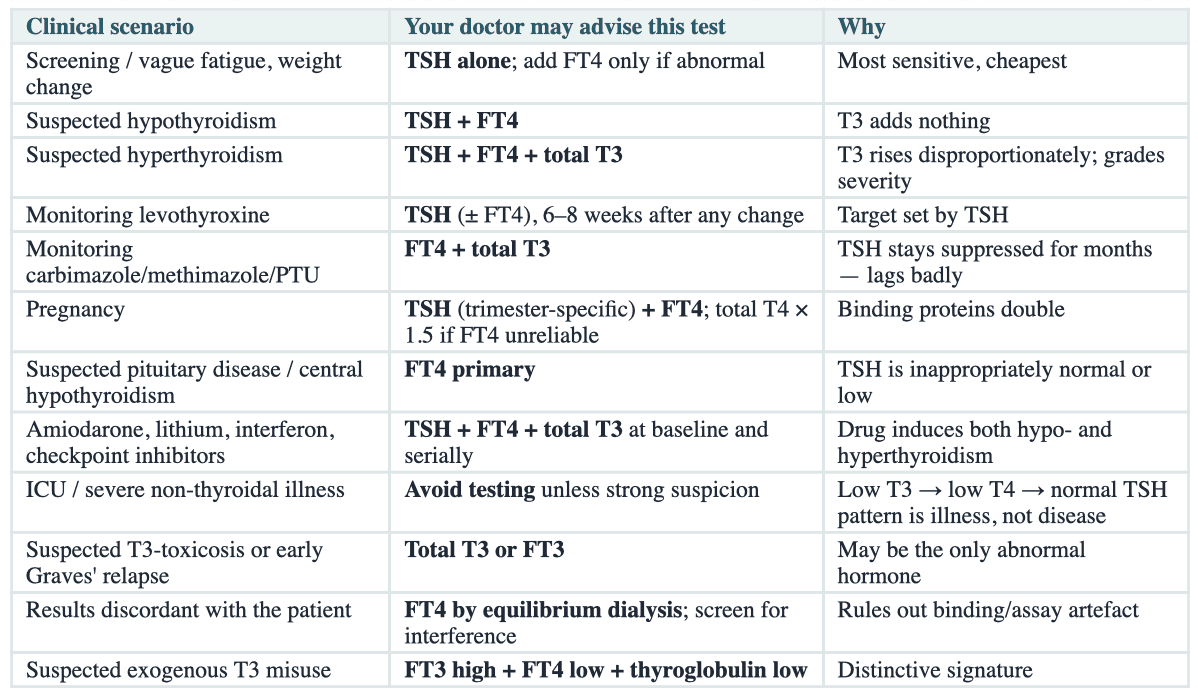
9. Which test, in which scenario
Thyroid antibodies, explained simply
Your immune system sometimes attacks your own thyroid by mistake. Antibodies are the weapons it makes — and measuring them tells you why a thyroid is misbehaving, not just that it is. Hormone tests measure how the gland is performing; antibody tests identify who is interfering with it.
Anti-TPO — "is my immune system attacking my thyroid?"
Present in about 95% of Hashimoto's and 75% of Graves'. But a positive result alone doesn't mean you're ill — roughly 1 in 10 healthy people carry these antibodies and never develop disease.
Worth testing when:
Your TSH is mildly high but T4 is normal. The main reason. It predicts progression: with a raised TSH and positive antibodies, about 4 in 100 people per year develop full hypothyroidism, versus about 2.6 in 100 with a raised TSH alone — which helps decide between treating now and watching.
You're pregnant or planning pregnancy with TSH in the 2.5–4.0 grey zone, or being investigated for recurrent miscarriage or infertility.
You have a neck swelling, fluctuating results, or another autoimmune condition (type 1 diabetes, coeliac disease, vitiligo).
Before starting amiodarone, lithium, interferon or immunotherapy.
Skip it when: you feel well with a normal TSH, or you already know you have Hashimoto's. Repeat testing serves no purpose.
Anti-Tg — mostly a thyroid cancer test
Adds little beyond anti-TPO for diagnosis. Its real purpose is different: after thyroid cancer surgery, doctors track a marker called thyroglobulin to detect recurrence, and anti-Tg interferes with that test — usually pushing it falsely low, which could hide a return of disease. So it's measured alongside every thyroglobulin test to confirm the result can be believed.
Test when: you're in thyroid cancer follow-up, or anti-TPO is negative but Hashimoto's is still strongly suspected. Otherwise skip it.
TRAb and TSI — the Graves' disease tests
Both look for antibodies against the TSH receptor — the docking point where the pituitary's instruction normally lands. These antibodies jam into that dock and imitate the instruction, so the thyroid keeps producing hormone regardless of what the brain wants.
10. Thyroid antibodies, explained simply
Your immune system sometimes attacks your own thyroid by mistake. Antibodies are the weapons it makes — and measuring them tells you why a thyroid is misbehaving, not just that it is. Hormone tests measure how the gland is performing; antibody tests identify who is interfering with it.
Anti-TPO — "is my immune system attacking my thyroid?"
Present in about 95% of Hashimoto's and 75% of Graves'. But a positive result alone doesn't mean you're ill — roughly 1 in 10 healthy people carry these antibodies and never develop disease.
Worth testing when:
Your TSH is mildly high but T4 is normal. The main reason. It predicts progression: with a raised TSH and positive antibodies, about 4 in 100 people per year develop full hypothyroidism, versus about 2.6 in 100 with a raised TSH alone — which helps decide between treating now and watching.
You're pregnant or planning pregnancy with TSH in the 2.5–4.0 grey zone, or being investigated for recurrent miscarriage or infertility.
You have a neck swelling, fluctuating results, or another autoimmune condition (type 1 diabetes, coeliac disease, vitiligo).
Before starting amiodarone, lithium, interferon or immunotherapy.
Skip it when: you feel well with a normal TSH, or you already know you have Hashimoto's. Repeat testing serves no purpose.
Anti-Tg — mostly a thyroid cancer test
Adds little beyond anti-TPO for diagnosis. Its real purpose is different: after thyroid cancer surgery, doctors track a marker called thyroglobulin to detect recurrence, and anti-Tg interferes with that test — usually pushing it falsely low, which could hide a return of disease. So it's measured alongside every thyroglobulin test to confirm the result can be believed.
Test when: you're in thyroid cancer follow-up, or anti-TPO is negative but Hashimoto's is still strongly suspected. Otherwise skip it.
TRAb and TSI — the Graves' disease tests
Both look for antibodies against the TSH receptor — the docking point where the pituitary's instruction normally lands. These antibodies jam into that dock and imitate the instruction, so the thyroid keeps producing hormone regardless of what the brain wants.

Test when:
Your thyroid is overactive and the cause is unclear. The main use — it separates Graves' from a nodule or temporary inflammation, which need completely different treatment. Often avoids a radioactive scan, and is the preferred route in pregnancy and breastfeeding, where scans aren't permitted.
You're pregnant and have Graves' now, or ever did — including if you were cured years ago and are well today. This is the one that gets missed: these antibodies cross the placenta and can affect the baby's thyroid even when yours is normal. Test at the first visit; if raised, repeat at 18–22 and 30–34 weeks.
You're deciding whether to stop anti-thyroid tablets — antibodies still high after 12–18 months means relapse is likely.
Your results swing between overactive and underactive, or a newborn has thyroid problems — here the TSI test specifically earns its cost.
Skip it when: you simply have an underactive thyroid, or as a routine monthly check. Use it at decision points.
11. Pitfalls that produce fake results
Biotin (>5 mg/day, common in hair/nail supplements) corrupts streptavidin-biotin assays: falsely high FT4/FT3 and falsely low TSH — a near-perfect mimic of Graves'. Stop biotin at least 2–3 days before testing.
Heterophile antibodies or macro-TSH → falsely high TSH in a euthyroid person. Repeat on a different platform.
Familial dysalbuminaemic hyperthyroxinaemia → high total T4 and spuriously high FT4 with normal TSH; the patient is euthyroid.
Cross-lab comparison — platforms are not interchangeable. Track trends on one lab.
Levothyroxine taken before the draw → FT4 peaks 2–4 hours post-dose and reads ~15–20% high. TSH is unaffected. Draw before the dose.
How to prepare:
Morning, fasting if possible, before your levothyroxine dose, same lab each time, at least 6–8 weeks after any dose change. Disclose biotin, amiodarone, lithium, oestrogen, steroids and immunotherapy.
12. Common questions
Q1 : Do I need to fast before a thyroid test?
Not strictly — TSH isn't a fasting test. But it's highest overnight and lowest mid-afternoon, so testing at the same time each visit matters more than fasting. For borderline results, that consistency can decide whether you're called abnormal.
Q2 : Should I take my levothyroxine before the blood draw?
No — blood first, then your dose. FT4 peaks 2–4 hours after a tablet and reads about 15–20% high, which can look like over-replacement.
Q3 : Why did my doctor order only TSH and not a full panel?
Because TSH amplifies. With an intact pituitary, a normal TSH makes significant thyroid disease unlikely — adding FT3, total T3 and total T4 up front usually buys confusion rather than information.
Q4 : My TSH is normal but I still feel exhausted. What now?
A normal TSH means the thyroid is unlikely to be the cause — not that nothing is wrong. Fatigue has a long list of causes: low iron, low B12, sleep apnoea, depression, coeliac disease, diabetes. Widen the search rather than re-testing the thyroid.
Q5 : How long should I wait after a dose change before retesting?
6–8 weeks. T4 lasts about a week in the body and the pituitary needs several of those cycles to settle. Testing at 2–3 weeks gives a number still in motion, and often triggers an unnecessary second dose change.
Q6 : I have been diagnosed with hypothyroidism. What happens next?
The path is well-worn and usually uneventful:
You start levothyroxine — one tablet daily on an empty stomach, 30–60 minutes before breakfast, with water. Keep calcium, iron and antacids about 4 hours away; they block absorption.
Wait 6–8 weeks, then retest TSH. The dose is adjusted if needed and the cycle repeats. Two or three rounds to find the right dose is normal, not a setback.
Symptoms lag behind the blood test. First improvement in 2–3 weeks, full effect over 2–3 months. Feeling unchanged at week two doesn't mean it's failed.
Once stable, testing drops to once a year — sooner if you become pregnant or plan to, if symptoms return, if your weight changes a lot, or if you start a new medicine.
Stay on the same brand and the same lab where you can. Both reduce unnecessary fluctuation.
It's usually lifelong, and that's not alarming. Treated hypothyroidism doesn't shorten your life or limit what you can do. Don't stop because you feel well — feeling well is the tablets working.
Q7: My anti-TPO is positive but my TSH is normal. Do I have thyroid disease?
Not necessarily — about 11% of healthy people carry them. It does mean higher future risk, so an annual TSH is reasonable, and test sooner if you become pregnant or develop symptoms.
Q8: Do antibody levels need re-checking? Can I make them go down?
They're a one-time prediction, not a disease-activity meter. They fluctuate, drift down over years, and a falling number doesn't mean the condition is reversing. No decision should hinge on the level. The exception is thyroid cancer follow-up, where anti-Tg is tracked deliberately.
Q9: My clinic recommends a reverse T3 test. Is it worth it?
No validated clinical role. Reverse T3 rises predictably in illness, starvation and after surgery — it marks being unwell, not "blocked thyroid hormone." No major guideline endorses it for diagnosis or dosing.
Q 10: How does HealthSutra help you understand and track your thyroid health?
Thyroid care is rarely about a single reading — it's about what your numbers do over months and years. HealthSutra is built around that:
It shows you your hormone trends — whether your TSH and thyroid hormones are rising, falling or holding steady, instead of leaving you to compare loose reports from different visits.
It sends follow-up reminders once you're on treatment, so the 6–8 week recheck after a dose change and the routine annual test don't get forgotten.
It tells you when the next test is due, and which one, so you repeat what's actually needed rather than paying for a full panel every time.
It adds lifestyle guidance on diet and exercise alongside your results, so the numbers connect to something you can act on.
The aim is straightforward: turn a scattered set of lab reports into a clear picture of your thyroid health over time — and make sure the next step never gets missed.
References
Unnikrishnan AG, Kalra S, Sahay RK, Bantwal G, John M, Tewari N. Prevalence of hypothyroidism in adults: An epidemiological study in eight cities of India. Indian Journal of Endocrinology and Metabolism. 2013 Jul;17(4):647–52. doi:10.4103/2230-8210.113755.
Marwaha RK, Tandon N, Ganie MA, Kanwar R, Sastry A, Garg MK, et al. Status of thyroid function in Indian adults: Two decades after universal salt iodization. Journal of the Association of Physicians of India. 2012;60:32–6.