Liver Tests
A plain-language guide to understanding your LFT report — what ALT, AST, ALP, GGT, bilirubin, albumin and INR mean, how doctors read abnormal patterns, and what your results may tell you about your liver health.
Written by Dr. Nimisha Gupta, M.D. Pathology
7 mins

Start here: what your liver actually does
Before the numbers make sense, it helps to know what the organ is for. Your liver sits under the right side of your ribcage, weighs about 1.5 kg, and runs roughly 500 jobs at once. Four of them matter for reading your report:
• It filters. Everything you swallow — food, alcohol, paracetamol, protein powder, ayurvedic churna —
passes through it first.
• It manufactures. Albumin, clotting factors, bile, cholesterol.
• It stores. Glucose as glycogen, plus iron and vitamins A, D and B12.
• It drains. It makes bile and sends it down the bile ducts into the intestine to digest fat.
Nearly every abnormal LFT is a story about one of these four functions going wrong.
The single most important thing to understand about the
"LFT"
Most of a liver function test does not measure liver function.
That sounds like a technicality. It is not the reason patients panic unnecessarily and, occasionally, the reason serious disease gets missed.
Your panel contains two very different kinds of measurement:
Leakage markers (ALT, AST, ALP, GGT). These are enzymes that normally live inside liver cells and bile duct cells. When those cells are irritated, inflamed, or dying, the enzymes spill into the bloodstream. High numbers mean damage is happening. They do not tell you whether the liver is still doing its job. A liver can leak enzymes furiously and still function fine.
True function markers (albumin, bilirubin, PT/INR). These measure output — what the liver is actually producing and clearing. When these go wrong, the liver's capacity is failing.
This is the difference between an engine making a bad noise and the car not moving. Both matter. They are not the same news.
A corollary that surprises people: a person with established cirrhosis can have a completely normal ALT. By that stage, there may be too few working liver cells left to leak much of anything. Normal enzymes are reassuring, but they are not proof of a healthy liver.
The markers, one by one :
ALT (also printed as SGPT)
What it is: An enzyme concentrated almost exclusively in liver cells.
What it means: ALT is the most liver-specific number on the page, and the workhorse of the panel. When
it's up, something is irritating your liver cells.
One caveat about "normal." Most labs print an upper limit of 40–55 U/L. Those ranges were originally
derived from populations that quietly included people with undiagnosed fatty liver, so the "normal" bar
was set too high.
The correction traces to a specific study. In 2002, Prati and colleagues re-derived the range from 6,835
first-time blood donors in Milan, this time excluding anyone with hidden liver disease or metabolic risk,
and found a healthy ceiling of 30 U/L in men and 19 U/L in women, well below what labs were
printing. Adopting it raised sensitivity for real liver injury by about 21%. (Prati D, et al. Ann Intern Med
2002;137:1–10)
The ACG's 2017 guideline on abnormal liver chemistries now puts the healthy range at 29–33 U/L for
men and 19–25 U/L for women, and advises that values above this be assessed rather than waved
through (Kwo PY, Cohen SM, Lim JK. Am J Gastroenterol 2017;112:18–35; doi:10.1038/ajg.2016.517).
So if your report says 38 U/L with a "normal" flag next to it, that is worth a conversation, not a shrug.
AST (also printed as SGOT)
What it is: A similar enzyme — but it also lives in heart muscle, skeletal muscle, and red blood cells.
What it means: AST rises with liver injury, but also after a hard gym session, a muscle injury, a heart
attack, or if the blood sample was handled roughly and the cells burst.
Practical rule: If AST is high and ALT is normal, think non-liver causes first , especially muscle. A CPK test
settles it quickly.
The AST/ALT ratio — a genuinely useful clue
Divide AST by ALT:
• Ratio below 1 (ALT higher than AST) — the typical pattern in fatty liver disease and chronic viral
hepatitis.
• Ratio above 2, especially with a raised GGT and both values under about 300 U/L — the classic
signature of alcohol-related liver injury.
• Ratio rising above 1 in someone with known fatty liver — a hint that scarring (fibrosis) may be advancing. This ratio is a clue, not a verdict. Don't diagnose yourself with it.
ALP (Alkaline Phosphatase)
Understanding Your Liver Function Test · 3
What it is: An enzyme lining the tiny bile channels inside the liver — and also, importantly, bone.
What it means: A rise in ALP points to the drainage system, not the liver cells — blockage or irritation of
the bile ducts: gallstones, a narrowed duct, drug reactions, or autoimmune duct disease.
The trap: ALP is normally high in growing children and teenagers, and in the third trimester of pregnancy.
An isolated high ALP is not automatically a liver problem.
GGT (Gamma-Glutamyl Transferase)
What it is: Another bile-duct enzyme, but with no bone source.
What it means: GGT's main job is to answer one question — is this high ALP coming from the liver or the
bone? If ALP is high and GGT is high too, the source is the liver. If ALP is high and GGT is normal, look at bone.
Its main weakness: GGT is sensitive to alcohol — but also to phenytoin, rifampicin and simple obesity. A raised GGT is not proof that someone drinks. It is one of the most over-interpreted numbers in medicine.
Bilirubin — total, direct, indirect
What it is: The pigment left over when old red blood cells are broken down. The liver picks it up,
packages it ("conjugates" it) and dumps it into bile. Your report splits it into indirect (not yet processed)
and direct (processed but not excreted).
How to read the split:
Mostly indirect → either too much bilirubin is being produced, or the liver's uptake machinery is slightly slow. The commonest cause by far is Gilbert's syndrome — a harmless inherited quirk affecting somewhere between 2% and 20% of people depending on ethnicity. Total bilirubin sits mildly raised, everything else is normal, and the number climbs when you fast, skip sleep or get a fever. It needs no treatment and shortens no lives.
Mostly direct → the liver processed the bilirubin but couldn't get rid of it. This is the more meaningful pattern and points to liver cell disease or a blocked bile duct.
When you can see it : Jaundice becomes visible above about 2.5–3 mg/dL. Dark urine appears earlier, and pale clay-coloured stool means bile isn't reaching the intestine at all — a get-seen-soon sign.
Albumin
What it is: The main protein the liver manufactures.
What it means: A genuine function marker. Low albumin can mean lost manufacturing capacity — but only after months, since albumin survives about 20 days in the blood. It marks chronic disease, not acute injury.
The caveat: Albumin also falls with malnutrition, protein-losing kidney or gut disease, and any significant inflammation. A low albumin is never a liver diagnosis on its own.
Total protein and the A/G ratio
Total protein = albumin + globulins. In chronic liver disease albumin falls while globulins rise, so the A/G ratio reverses (drops below 1). A soft supporting clue, not a decisive one.
PT / INR — the most underrated number on the page
What it is: A clotting time. The liver makes most clotting factors.
Why it matters: One key clotting factor lasts only about 6 hours, so unlike albumin, INR reacts to liver trouble within hours. In acute injury it is the clearest signal that the liver is losing function, and it often decides whether someone is treated at home or admitted. A climbing INR in someone not on a blood thinner is not a wait-and-watch number.
Platelet count — technically not an LFT, but read it anyway
If your full blood count shows a platelet count below 150,000, and there's no other explanation, it can be an early fingerprint of liver scarring. A scarred liver raises pressure in the portal vein, the spleen enlarges, and the enlarged spleen traps platelets. Falling platelets in a patient with fatty liver is often the first hint that fibrosis has quietly progressed.
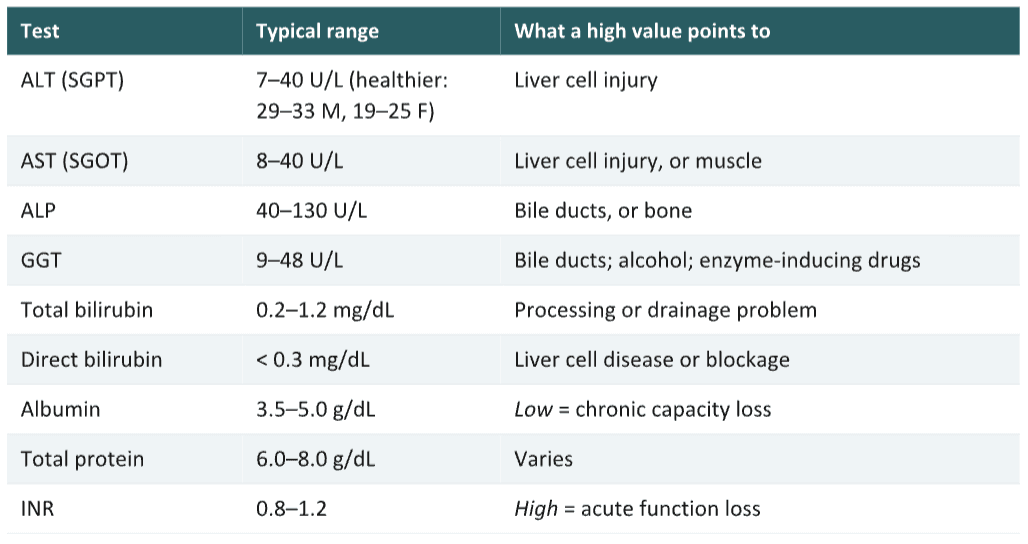
A reference table — with a warning
Ranges vary between laboratories.
Always compare your value to the range printed on your report, not a
range from the internet. These are typical adult values:
How doctors actually read the report: pattern, then
magnitude
Experienced clinicians don't read your LFT line by line. They ask two questions in order.
Question 1 — What is the pattern?
Hepatocellular pattern: ALT and AST disproportionately raised compared to ALP. The problem is with the liver cells. Think viral hepatitis, fatty liver, alcohol, drug reactions, autoimmune hepatitis.
Cholestatic pattern: ALP and GGT are disproportionately raised compared to ALT. The problem is with the drainage. Think gallstones, a stricture, a mass pressing on the duct, or certain drugs.
Mixed pattern: Both. Common with drug-induced injury.
Doctors formalise this with the R factor — (your ALT ÷ its upper limit) divided by (your ALP ÷ its upper limit). Above 5 is hepatocellular; below 2 cholestatic; in between mixed. The pattern decides what happens next: hepatocellular leads to blood
Question 2 — How big is the rise?
For the transaminases (ALT/AST), magnitude narrows the field dramatically:
• Mild (under 5× the upper limit). Overwhelmingly the commonest. Usually fatty liver, alcohol, a
medication, or chronic hepatitis B or C.
• Moderate (5–15×). Acute viral hepatitis, drug injury, autoimmune or alcoholic hepatitis.
• Massive (over 15×, often above 1,000 U/L). A short list: paracetamol overdose, acute viral hepatitis,
"shock liver" after low blood pressure, severe autoimmune hepatitis, or a stone acutely jamming the duct. This needs same-day attention.

The five scenarios that explain most abnormal reports
Fatty liver (now called MASLD). By far the most common — mildly raised ALT, usually above AST. Its
own section follows.Alcohol. AST above ALT by two-fold or more, GGT raised, neither transaminase especially high in
absolute terms.Medications and supplements. Anti-tuberculosis drugs, methotrexate, some antibiotics, anti-
epileptics, statins, and — critically — many herbal, ayurvedic, bodybuilding and weight-loss products.
Supplements account for about 20% of cases in the US drug-injury registry and 13–14% in Indian series,
almost certainly an undercount.Viral hepatitis. B and C can stay silent for decades with only mild enzyme elevation. Both are testable
and treatable — hepatitis C is now curable in most cases with a short oral course. A and E cause dramatic,
short-lived spikes.Bile duct obstruction. ALP, GGT and bilirubin up, often with right upper abdominal pain, dark urine,
pale stool and itching.
The one you are most likely to have: Fatty liver
This deserves its own section purely because of scale. A meta-analysis pooling 50 Indian studies
estimated fatty liver in 38.6% of Indian adults — and 35.4% of children. In high-risk groups (obesity,
diabetes, coronary disease) it reaches 52.8%. Roughly one in three adults. (Prevalence of NAFLD in India: systematic review and meta-analysis)
It is almost entirely silent. No pain, no jaundice, no symptom anyone would connect to the liver. Which is why most people don't discover it deliberately — they find out by accident, when an ultrasound done as part of a corporate health package, or ordered for gallstones or vague abdominal discomfort, comes back with a line reading "Grade 1 fatty liver; That incidental sentence is how this diagnosis is usually made in India.
How it progresses. Four stages, and most people never leave the first:
Simple fat (steatosis). Fat inside liver cells, no inflammation. Fully reversible.
Steatohepatitis (MASH). Fat plus inflammation. Enzymes may start rising here. Still reversible.
Fibrosis. Scar tissue begins replacing working tissue. Partly reversible.
Cirrhosis. Architectural scarring, largely irreversible, and carrying a risk of liver cancer.
Progression is slow — typically decades — and most people never travel the full distance. Poorly
controlled diabetes is the strongest accelerator.
What drives it. Visceral fat and insulin resistance above all, plus refined carbohydrate and sugar
(sweetened drinks especially), sedentary work, poor sleep, and genetic susceptibility.
And you do not have to be obese. Roughly one in eight non-obese South Asians has it. "Lean fatty liver"
is real: South Asians deposit fat around the organs at lower BMIs than other populations, so a normal
weight on the scale is not protection. Waist circumference is the more honest measurement.
What can throw your results off
Before assuming disease, rule out noise:
• A hard workout in the 2–3 days before the test can raise AST and ALT.
• A long gap without food raises bilirubin in people with Gilbert's syndrome.
• Recent drinking, even a single occasion, moves GGT and AST.
• A difficult blood draw that breaks red cells falsely raises AST and bilirubin.
• New supplements or antibiotics in the preceding weeks.
• Pregnancy raises ALP substantially; it's expected.
Mild, isolated abnormalities are often worth simply repeating after 4–6 weeks, with none of the above in play.
What an LFT cannot tell you
This is the guide's most important section.
It cannot, by itself, tell you whether you have scarring. The enzymes measure inflammation — whether liver cells are being irritated now. They say nothing directly about fibrosis, the scar tissue that years of quiet irritation leave behind. Someone can carry significant fibrosis behind a normal-looking panel.
The estimate does, however, come from numbers you already have. The FIB-4 index is calculated from your age, your AST, your ALT and your platelet count from the blood count, and it indicates the likelihood of scarring.
Two caveats worth carrying:
• FIB-4 loses accuracy at the extremes of age.
• An indeterminate or high score is a prompt for the next test — usually a FibroScan — not a diagnosis.
It cannot give you a diagnosis. It tells you which direction to look.
It cannot exclude liver disease. Normal enzymes plus a large waistline, plus diabetes, plus a fatty liver on ultrasound still adds up to a liver that needs attention.
Building a preventive liver check that actually works
If an LFT alone is not enough, what should a preventive check contain? Three things, not one:
5. Liver panel plus a complete blood count. The panel for inflammation; the blood count because you
need the platelet figure to compute FIB-4.
6. FIB-4, calculated from those two. No extra sample, no extra cost.
7. An abdominal ultrasound. This is the part that actually detects fat. Your LFT can be entirely normal in
a liver visibly loaded with it — which is exactly why the two belong together.
Know what the ultrasound can and cannot do. It is cheap, safe, radiation-free and available in every
small town, which is why it is the practical first test in India. But it is insensitive to mild fat. In one study of
patients with type 2 diabetes, standard B-mode ultrasound detected fatty liver with only about 64% sensitivity, dropping to 36–43% in the merely overweight; it performed well only for severe steatosis. (Diagnostic performance of greyscale ultrasound in detecting fatty liver disease) Grading is also operator- dependent. A normal ultrasound is reassuring, not conclusive.
Who should be checked, and how often:
• Diabetes, pre-diabetes, obesity, high triglycerides, or metabolic syndrome — panel + blood count + FIB-4 yearly, with an ultrasound at baseline.
• A raised waist (over roughly 90 cm in men, 80 cm in women) even at a normal BMI — same schedule.
• Everyone, once: hepatitis B and C screening. Both are silent for decades and both are treatable.
• If FIB-4 is indeterminate or high — proceed to a FibroScan rather than repeating the same blood tests.
What to skip: stand-alone "liver detox" or "liver tonic" panels, and repeating an ultrasound every six months when nothing has changed. The useful repeat interval is annual, and the useful thing to track is the trend in FIB-4 and waist size, not the third decimal place of your SGPT.
When to stop reading and seek care
Contact a doctor the same day if you have:
• Yellow eyes or skin, especially of recent onset
• Pale, clay-coloured stool with dark urine
• Confusion, unusual drowsiness, day-night reversal, or a coarse hand tremor
• Vomiting blood, or black tarry stool
• A rapidly swelling abdomen or new leg swelling
• Fever with pain in the upper right abdomen
• ALT or AST above 1,000, or a rising INR without a blood thinner
In the consulting room: what patients actually ask
Patient: My SGPT is 62 and the limit is 40. Is my liver damaged?
Doctor: Not in the sense you're imagining. That's a mild elevation, and mild elevations rarely mean serious disease on their own. It tells me something is irritating your liver cells — usually fat, alcohol, or a medicine. My job now is to find out which.
Patient: I don't drink at all. How can I have a fatty liver?
Doctor: Because the commonest cause here has nothing to do with alcohol. It's metabolic — it travels with an expanding waistline, insulin resistance and high triglycerides. South Asians tend to store fat around the organs rather than under the skin, so the weighing scale can look reassuring while the liver is not.
Patient: My GGT is high. My wife now thinks I'm hiding a drinking problem.
Doctor: Let me settle that. GGT rises with alcohol, but also with obesity, fatty liver, diabetes and several common medicines. On its own it is not evidence that anybody drinks. If I genuinely suspected alcohol I'd be looking at the whole picture, not one enzyme.
Patient: My bilirubin has been slightly high for ten years and nobody has explained it.
Doctor: If it's the indirect fraction, everything else is normal, and it climbs when you've fasted or been unwell, that's almost certainly Gilbert's syndrome — an inherited variation, not a disease. No treatment, no diet, no follow-up. Just mention it if you are ever prescribed chemotherapy.
Patient: Should I stop my medicines to rest my liver?
Doctor: Please don't stop anything before we talk — especially blood pressure or diabetes medicines.
But bring me every bottle in the house, including the ones you don't think of as medicine: the ayurvedic powder, the gym protein stack, the weight-loss capsules. Supplements are a common and badly under-reported cause of liver injury.
Patient: My chemist suggested a liver tonic.
Doctor: No. Nothing in a bottle has good evidence behind it, and some "detox" products have themselves caused liver injury. If you want something that works, lose weight, five percent reduces the fat, seven to ten percent settles the inflammation, ten percent or more is where scarring starts to reverse.
Patient: My enzymes are normal now. So my liver is healthy?
Doctor: Not automatically, and this is the one thing I'd like you to remember. Enzymes measure inflammation, not scarring — an already-scarred liver may have too few active cells left to leak much of anything. That's why I want to look at scarring directly rather than rely on a calm-looking report.
Patient: When should I repeat this?
Doctor: In six to eight weeks, and in the fortnight before, no alcohol, no new supplements, and no hard workout in the two days before the draw. Those three alone resolve a fair number of abnormal reports. If it falls, we monitor. If it's stable, we complete the workup. If it climbs, or your bilirubin or INR starts moving, we escalate.
What actually moves these numbers
For the most common cause, metabolic fatty liver, the evidence is unusually clear:
• Weight loss, in a dose-response relationship. Losing 5% or more reduces liver fat; 7–10% improves
inflammation and resolves steatohepatitis in most people; 10% or more is where scarring meaningfully reverses — in the landmark study, 45% of those losing ≥10% had fibrosis regression, versus 16% of those losing 7–10%. This is the single highest-yield intervention available, and it outperforms every supplement marketed for liver health.
• 150 minutes a week of moderate exercise reduces liver fat even without weight loss.
• Cutting alcohol improves GGT and AST within weeks.
• Controlling diabetes, blood pressure and lipids — the liver is a metabolic organ and responds to metabolic control.
• Auditing your supplement shelf with your doctor. Stopping the wrong bottle can normalise a panel entirely.
• Vaccination against hepatitis A and B.
Coffee, oddly, is repeatedly associated with lower enzymes and less fibrosis. Milk thistle and "detox" kits are not.
Key references
The claims in this guide that rest on specific research, with links:
• Healthy ALT is lower than most labs print — Prati D, et al. Updated definitions of healthy ranges for serum ALT. Ann Intern Med 2002;137:1–10. pubmed.ncbi.nlm.nih.gov/12093239
• Current guideline thresholds and the hepatocellular/cholestatic framework — Kwo PY, Cohen SM,
Lim JK. ACG Clinical Guideline: Evaluation of Abnormal Liver Chemistries. Am J Gastroenterol 2017;112:18–35. doi:10.1038/ajg.2016.517
• Fatty liver in 38.6% of Indian adults — Prevalence of NAFLD in India: a systematic review and meta- analysis. J Clin Exp Hepatol 2022. pubmed.ncbi.nlm.nih.gov/35677499
• Ultrasound misses mild fatty liver — Diagnostic performance of greyscale ultrasound in detecting fatty liver disease in type 2 diabetes. ncbi.nlm.nih.gov/pmc/articles/PMC10284594
• The weight-loss dose-response for inflammation and fibrosis — Vilar-Gomez E, et al. Gastroenterology 2015;149:367–378. PMID 25865049
• FIB-4 as first-line fibrosis assessment — AGA/AASLD/EASL non-invasive testing pathways; original derivation Sterling RK, et al.
A closing note
An abnormal LFT is a prompt to investigate, not a diagnosis. Most mildly abnormal reports trace back to fatty liver, alcohol or a medication — all addressable, and most reversible if caught before scarring sets in. The liver is the only major internal organ that can regenerate, so it gives you a long runway. The mistake worth avoiding isn't panicking at a raised number's filing away three years of "slightly high, doctor said watch it"without ever checking whether scarring has begun.
This guide is for general education and cannot substitute for assessment by a qualified doctor who has your full history, examination findings, and complete results. Please discuss your specific report with your physician